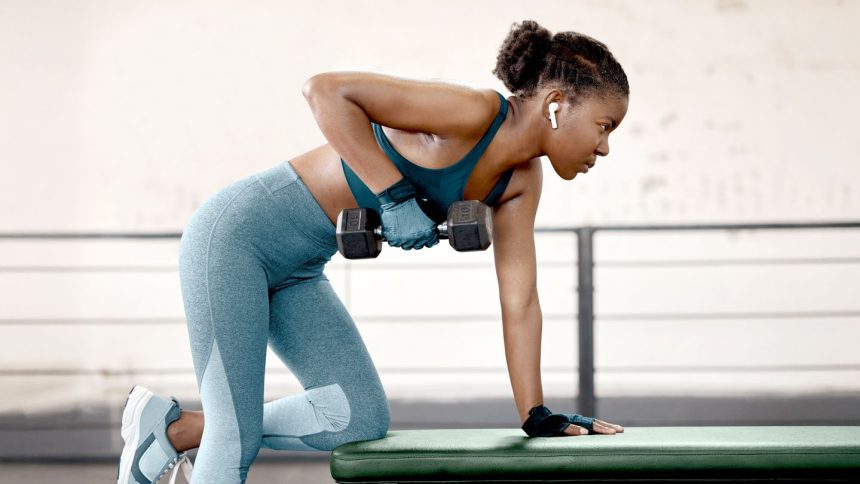
What’s the typical charge of muscle acquire? Everybody’s physique responds a bit of otherwise to energy coaching, so the brief reply is “it relies upon.” One assessment of analysis on how resistance coaching impacts muscle progress discovered that there’s a vary within the quantity of muscle gained over time.
However normally, the typical exerciser can count on to realize 0.5 to 2 kilos of muscle in a single month of coaching, in line with the American Council on Train.
How does muscle progress happen?
In case you’ve chosen muscle constructing as a health precedence, it may possibly make it easier to perceive how your physique places on further muscle. In any other case, it’s possible you’ll end up doing one thing that’s truly counterproductive to your objectives.
In a nutshell, analysis exhibits that intense train like resistance coaching prompts satellite tv for pc cells on the surface of muscle fibers, inflicting them to proliferate and fuse, forming new muscle fibers and repairing outdated muscle fibers.
Nevertheless, this doesn’t occur throughout coaching. Analysis has proven that this occurs throughout your post-workout relaxation. So in relation to weight coaching, the “extra is healthier” mentality might be counterproductive.
The reality is that extra stimulation normally means higher outcomes, however provided that you give your muscle tissues sufficient relaxation and restoration time between matches. In any other case, your muscle tissues is not going to be given time to return to their authentic state.
Learn how to monitor muscle features
Particular person responses to energy and hypertrophy, or muscle progress, can range significantly even underneath the identical stimulus. Analysis exhibits that age, gender, and coaching standing can all affect a person’s charge of muscle acquire.
So what’s the easiest way to estimate muscle mass gained, particularly with generally conflicting analysis on which strategies lead to essentially the most muscle progress?
The dimensions in all probability does not. The Cleveland Clinic factors out that weighing your self is not essentially the easiest way to measure muscle progress, since your weight can fluctuate ceaselessly attributable to water retention, hormonal adjustments, adjustments in physique fats, and even what you ate for breakfast.
Monitoring how a lot weight you possibly can raise is one straightforward, however not correct, strategy to estimate muscle acquire. Though the connection between energy and muscle measurement varies from individual to individual, will increase in energy are considerably correlated with will increase in muscle measurement.
Though many research help the connection between muscle density and measurement, remember the fact that measuring muscle density is unattainable for most individuals to do at dwelling.
In accordance with the Cleveland Clinic, one pound of muscle takes up much less house in your physique than one pound of fats. So even when the size does not change, monitoring the match of your garments can inform you how your physique composition is altering from fats tissue to muscle.
In case you’re critical about monitoring your muscle acquire charge, a versatile tape measure could possibly be simply the instrument you want. Measure across the muscle tissues you wish to monitor, similar to your higher arm or thigh, at set factors utilizing markers similar to the highest of your hipbone, the tip of your elbow, or the bump on the prime of your shoulder.
Make certain to put in writing down these measurements and revisit them usually, all the time measuring on the identical level towards the marker.
Suggestions for selling muscle progress
One strategy to construct extra muscle is so as to add extra units. A examine evaluating how individualized and normal approaches to weight coaching affected muscle progress discovered that not solely had been personalized packages simpler, however a average improve within the variety of units carried out (by about 20 %) was more than likely to advertise muscle progress.
Different analysis helps the concept that the variety of units you carry out is an effective strategy to monitor your coaching quantity, or the overall quantity of weight you raise, within the pursuit of muscle progress.
Including every week of exercises may assist. Analysis exhibits that there isn’t any vital distinction within the effectiveness of energy coaching two to 4 occasions every week if the general quantity is identical, however including in additional quantity exercise periods might help energy and muscle features.
Analysis revealed in 2018 highlights the significance of resting every muscle group for at the very least 48 hours between intense exercises.
Growing the frequency or depth of your exercises needs to be carried out regularly to present your physique an opportunity to adapt. Doing an excessive amount of too shortly typically results in harm, which will certainly decelerate your muscle-building journey.
Vitamin that promotes muscle acquire
Going to the fitness center alone shouldn’t be sufficient to develop muscle tissues. To create new muscle tissue, your physique additionally wants the proper vitamins, particularly protein.
As analysis factors out, there may be debate about how a lot protein you really need. A scientific assessment and meta-analysis of the quantity of protein wanted to help muscle mass discovered that consuming 1.6 grams (g) of protein per kilogram (kg) of physique weight is adequate to keep up and construct muscle mass.
Different research have discovered that protein suggestions and consumption for athletes sometimes vary from 1.2 to 1.7 grams per kilogram of physique weight, or 2.2 kilos. The precise quantity you want will depend upon elements similar to whether or not your exercises lean towards endurance or energy coaching.
For most individuals, it is a lot simpler to calculate simply changing your weight to kilograms. To roughly convert, divide your weight in kilos by 2.2 to get your weight in kilograms.
For instance, in case you weigh 150 kilos, 150 ÷ 2.2 = 68.2 kilograms. Due to this fact, the best protein consumption could be between 1.2 × 68.2 = 81.8 g (decrease restrict) and 1.7 × 68.2 = 115.9 g (higher restrict) per day.