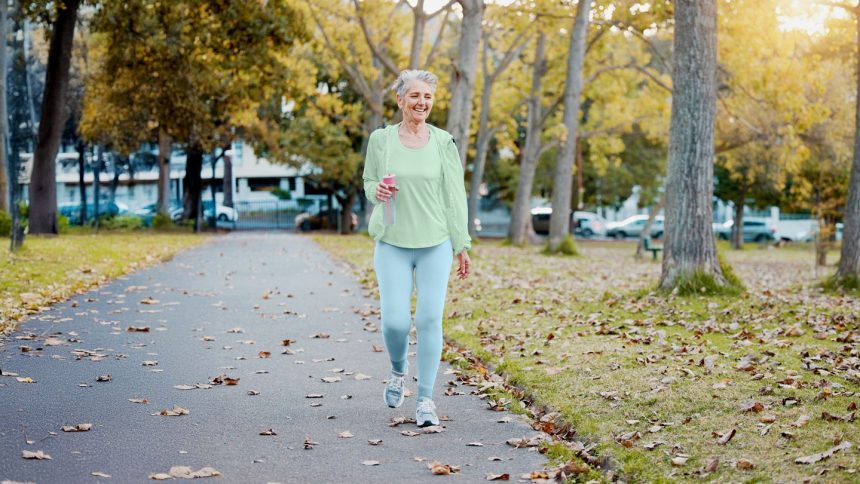
The research outcomes recommend that whereas the quantity of steps you stroll and the variety of steps you’re taking are essential in your well being, you needn’t obtain a sure variety of steps day-after-day or most days to decrease your danger of coronary heart illness and early loss of life, stated lead writer Rikuta Hamaya, M.D., Ph.D., professor of medication at Brigham and Girls’s Hospital and the Harvard T.H. Chan Faculty of Public Well being in Boston.
The findings present a easy and achievable purpose, particularly for older adults, who are typically much less lively, the authors stated.
What a stroll a few times every week can do for the well being of older ladies
The research adopted greater than 13,000 ladies over the age of 62 (common age 72) over every week as they wore a small gadget worn round their waists to trace their steps. After amassing information, contributors have been divided into teams primarily based on the variety of days they walked 4,000, 5,000, 6,000, or 7,000 or extra steps per week.
The researchers then adopted the contributors for a mean of about 11 years to see what number of ladies developed coronary heart illness or died. Key findings embrace:
- Girls who walked 4,000 steps only one or two days every week had a 26 p.c decrease danger of loss of life and a 27 p.c decrease danger of growing coronary heart illness in comparison with ladies who by no means accomplished 4,000 steps.
- Strolling 4,000 steps over three days reduces the chance of loss of life by 40%, however even for many who stroll greater than that, the impact plateaus at that time.
“From a behavioral perspective, you do not have to be lively day-after-day to get significant well being advantages,” says Dr. Deepika Radu, an affiliate professor and researcher specializing in way of life and behavioral well being promotion for power illness prevention at Northwestern Medication in Chicago.
“Nevertheless, setting a every day train purpose may also help you preserve consistency,” says Dr. Radu, who was not concerned within the research.
The outcomes additionally present that you just needn’t take extra steps to reap the well being advantages. An important factor, she says, is to easily transfer extra, even in sustainable patterns.
Simply an additional quarter-hour of strolling a day could make an enormous distinction.
Michael J. Lamonte, Ph.D., MPH, analysis professor within the Division of Epidemiology and Environmental Well being on the College at Buffalo, New York, agrees that the research outcomes are encouraging from a prevention perspective.
“You do not have to hit the standard purpose of 10,000 steps a day (about 5 miles) to decrease your danger of coronary heart illness and early loss of life,” Dr. LaMonte says. He has printed analysis on step rely and its results on well being, however was not concerned on this research.
To attain advantages much like these on this research, the common lady would want to take about 1,600 further steps a couple of days every week, however Lamonte says this quantity may be very doable with only a few tweaks to her common routine.
This quantity is equal to a number of extra 5-minute walks, one 15-minute stroll at a reasonable tempo, or an extra hour strolling round the home or backyard.
“It is also value noting that ladies who have been capable of stroll extra appeared to have a good stronger affiliation with a decrease danger of loss of life,” Lamonte says.
Taken collectively, these findings help the overall consensus within the bodily exercise and well being science group. In brief, he says, some exercise is healthier than no exercise, and up to some extent, it is higher to stroll extra typically.
Do wholesome individuals are likely to stroll extra?
As a result of the research tracked how a lot ladies walked in a typical week, moderately than giving them directions and measuring them in opposition to a management group, it is unimaginable to know whether or not strolling lowered their danger of coronary heart illness or early loss of life. Girls who really feel more healthy might merely be strolling extra, making their step rely a symptom moderately than a explanation for their well being situation.
Dr. Hamatani acknowledges that chance. To clarify that, the researchers performed a separate “sensitivity” evaluation to have a look at the outcomes that excluded coronary heart illness and loss of life throughout the first two years, in addition to individuals who reported good or poor well being, and that evaluation discovered related outcomes to the primary evaluation, Hamaya stated.
Coronary heart illness is extra frequent in ladies, however therapy is insufficient
Transfer the best way you need — profit it doesn’t matter what
This research confirmed that you just needn’t stroll rushing laps across the monitor to enhance your coronary heart well being. Any motion is ok. Lamonte stated the monitoring gadget used within the research solely measured the variety of steps taken, not the depth or distance walked at a time.
“That could possibly be sluggish or quick strolling, steady or intermittent strolling, strolling for transportation, leisure or recreation, or just transferring round the home throughout a traditional day,” he says.
Until you’ve gotten well being or mobility points that make strolling unsafe, it is a simple and cheap method to enhance your well being, Lamonte stated.
You do not have to trace your steps, however a pedometer or health tracker might assist inspire you to be extra constant and monitor your progress, he says.