
Do you know that your sensitivity to carbohydrates modifications all through the day? It is true, and this will have a huge impact on diabetes administration.
If you happen to’re an insulin-dependent diabetic like me, you in all probability have some sort of system for estimating the models of insulin you could boluse together with your meal.
Maybe you depend carbohydrates, calculate your dosage based mostly on complete energy, use a sliding scale, or just estimate the quantity of insulin you want based mostly in your expertise.
Nevertheless, I typically discover that persons are lacking a vital piece of the puzzle. Meaning it’s important to calculate your sensitivity to carbohydrates through the day.
As Gary Shiner explains in his ebook “Considering Like a Pancreas” (I posted a related excerpt in my publish Managing the Daybreak Phenomenon with Basal Insulin), our basal insulin wants range all through the day, and I discover that my sensitivity to carbohydrates varies broadly as nicely.
How do we all know this? Nicely, as a result of overlaying a given quantity of carbohydrates within the morning requires extra insulin than the very same sort and quantity of carbohydrates within the night.
Why is it vital to know your sensitivity to completely different carbohydrates?
If you wish to handle your diabetes as carefully as potential, it is extremely vital to to start with know precisely what your completely different sensitivities are. If you do not know what is going on on all through the day, you possibly can find yourself over- or under-dosing.
From a common well being and health perspective, that is removed from optimum, and also you danger using a curler coaster of high and low blood sugar all through the day. Not solely is that this very tiring, nevertheless it may also be very irritating as you do not perceive why you are all the time working at a excessive or low velocity.
For example you’re employed out within the afternoon and calculate your pre-workout consumption utilizing the identical components you utilize within the morning. If you happen to’re like me, you are extra prone to overdose when your want for insulin will increase within the morning. And everyone knows what which means. You may need to skip a exercise or eat further carbs that you just did not plan on or need.
discover and monitor your personal completely different carbohydrate sensitivities
Keep in mind how I used a blood sugar tracker to discover ways to cut back the chance of hypoglycemia throughout cardio train in my publish about consuming and insulin throughout exercises? The identical precept applies to discovering your sensitivity to completely different carbohydrates.
I like to recommend monitoring your blood sugar ranges for a few week and attempting to maintain every thing (weight loss plan, train, sleep, every day routine, and so on.) as constant as potential. Subsequent, discover out by testing your sensitivity to carbohydrates at completely different occasions of the day.
The best way to do that is to measure your blood sugar stage earlier than you eat and file it together with what you eat. Measure once more after 90 minutes. In case your blood sugar stage stays inside a constant vary 90 minutes after a meal, the dose is suitable. If not, you could make modifications.
These modifications may be made in collaboration together with your healthcare crew, however they’ll have to be supplied with information. In any other case, you will not know what modifications to make.
I’m self-managed. Which means you’re making modifications to your personal diabetes administration day-after-day as wanted. I attain out to Endo recurrently and self-monitoring has tremendously improved my high quality of life and diabetes administration, particularly contemplating how a lot my exercises have an effect on my insulin wants.
monitor and regulate your carbohydrate sensitivity
If you happen to’re utilizing an insulin pump, go to settings and you may see that your pump truly lets you set as much as six completely different carbohydrate and correction components. It’s possible you’ll not use it in the present day, however there is a cause pump producers included that possibility.
If you happen to’re in pen remedy like I’m, you will must both file every thing in your head (LOL! That requires extra mind energy than I’ve) or use some form of calculator. Beforehand, I used the RapidCalc app to trace every thing. Proven beneath is a screenshot of the present settings.
replace: The RapidCalc app is presently solely accessible within the EU app retailer for iPhone, however you possibly can change the settings to US after downloading. This video exhibits you the way.
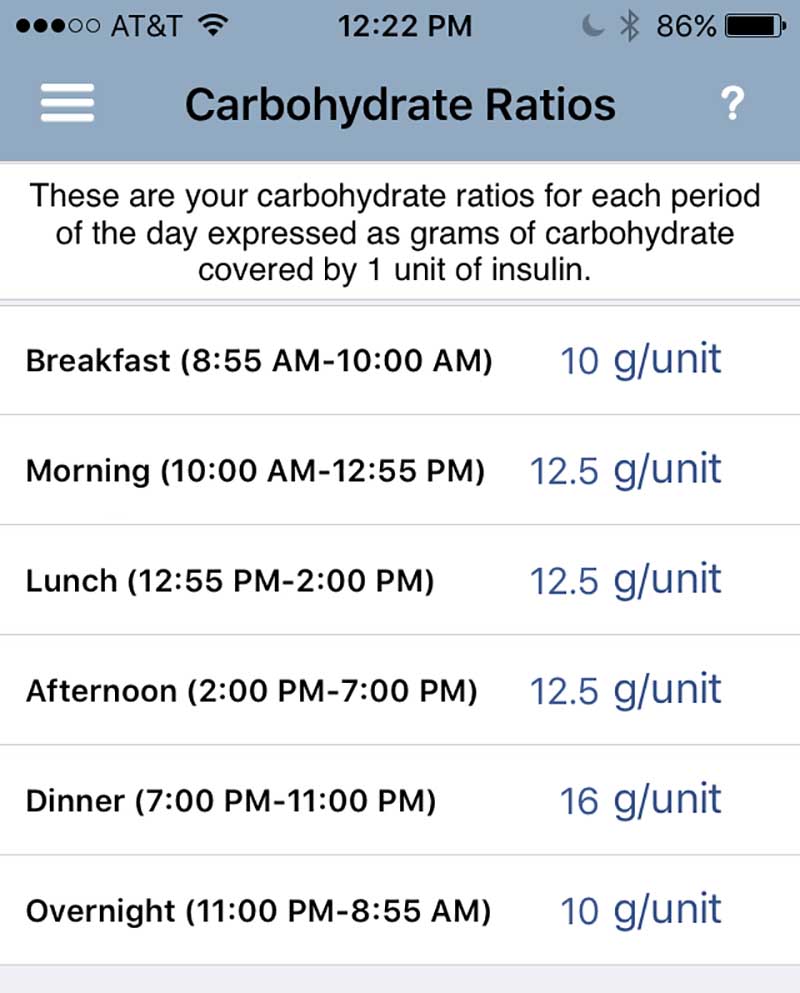
It is arrange very like a pump, so that you simply enter all of your info and it’ll calculate a really useful dose based mostly on the time of day and energetic insulin, similar to the pump.
As you possibly can see, I am not presently using all six settings, solely three completely different ratios, and the hours from 11pm to 10am require essentially the most insulin.
10 g/unit means you want 1 unit of insulin for each 10 g of carbohydrates throughout that interval, however only one unit of insulin for each 16 g of carbohydrates within the night.
If you happen to already handle fundamental blood sugar administration, you could wish to hone your diabetes administration abilities by discovering completely different ratios in your every day blood sugar ranges. Simply realizing what is going on on will make your life simpler and in the end provide you with much less time to appropriate or fear about low or excessive blood sugar.
We advocate the next publish: No-carb, low-carb, or moderate-carb – which is greatest for a diabetic weight loss plan?